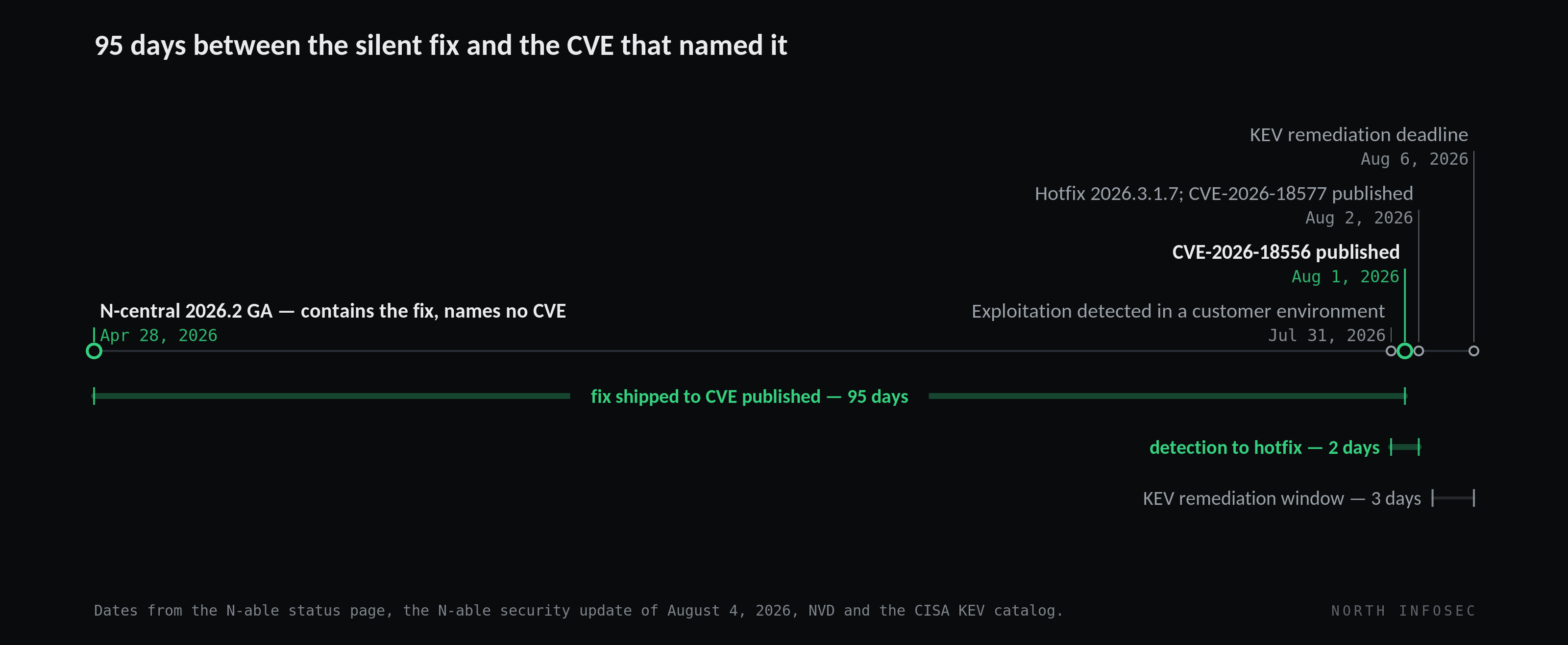
N-able published CVE-2026-18556 on August 1, 2026: an authentication bypass in N-central, its remote monitoring and management platform, affecting all versions through 2026.1. The fix had already shipped. N-central 2026.2 went generally available on April 28, and neither its announcement nor its release notes mention the vulnerability.
That leaves 95 days in which every N-central operator had the fix available and nothing telling them it mattered.
The CVE surfaced only because the fix turned out to be incomplete. On July 31 N-able's Adlumin MDR detected exploitation in a customer environment. The follow-up, CVE-2026-18577, is described by NVD as "an incomplete patch for CVE-2026-18556" and reaches every build through 2026.3.1. Hotfix 2026.3.1.7 shipped Sunday, August 2. CISA added 18577 to the KEV catalog on August 3 with a three-day remediation deadline, and 18556 on August 4.
Two ways to be wrong about one release
An MSP that deferred 2026.2 — a feature release, by its own announcement, with embedded AI guidance and better device filtering — stayed exploitable and had no signal to act on. An MSP that installed 2026.2 the week it shipped believed the issue was closed, and was still exploitable through 18577. Both were reasoning correctly from what the vendor published. The information needed to be right did not exist in either case.
What followed exploitation is why the blast radius sits with customers rather than with the platform. N-able's own account: the attacker took administrative access, "leveraged the Take Control feature and connected to systems within the N-central managed environment," then "registered a new service for a CloudFlare tunnel, enabling persistence into an environment after access to the N-central server was revoked." Read that last clause twice. Fixing the server does not evict anyone. A Cloudflare tunnel is an outbound connection, so it survives inbound firewall rules and looks like ordinary HTTPS egress from a managed endpoint.
The structural reason quiet fixes happen is not sinister. A release with no CVE attached generates no customer escalations, no emergency-change paperwork, and no trade coverage. The cost is paid by the customer, whose upgrade prioritisation runs on release notes — so the security value of a release is invisible in exactly the document used to decide whether to install it.
The practice: track the admin plane by advisory, not by release notes
Start with the list, because most teams have never written it down: which third-party software holds administrative privilege across your estate? RMM, backup, identity provider, hypervisor management, EDR console, deployment tooling. It is usually five to fifteen products, and each one can reach everything.
For those products only, watch a CVE feed keyed to the product rather than the vendor's blog. NVD publishes per-product feeds; a vendor blog tells you what the vendor chose to say, which in this case was nothing until August. The honest cost is noise — a raw CVE feed across a full software inventory is unreadable, which is why teams abandon it by week three. Scoping it to the admin-plane list keeps it to a few alerts a month and covers the systems where a compromise is total rather than local.
Then a sequencing rule that follows directly from those 95 days: for admin-plane software, do not defer a release on the grounds that the notes look like features. You cannot distinguish a security release from a feature release by reading the changelog, so the changelog cannot be the input to that decision. This costs a maintenance window on a system that is inconvenient to restart, several times a year. That is the real price and it is worth stating plainly, because it is why the rule gets waived.
Finally, treat a version number as a claim rather than a result. Confirming a fix means checking the behaviour, not the build string — and where you cannot check it yourself, the fallback is to reduce what an unauthenticated request can reach in the first place. An N-central server does not need to answer the entire internet; restricting the management interface to known networks limits who can even attempt an authentication bypass, working or otherwise. It is the same lesson as reading a data-plane log instead of an uptime graph: the instrument everyone watches was answering a different question than the one being asked.
What to check this week
- Write the admin-plane list. If it takes a meeting to produce, that is the finding.
- For each item, name where a security advisory for it would arrive, and who reads it. "Our vendor emails us" is not an answer if nobody can say which inbox.
- If you run N-central: are you on 2026.3.1.7, and did anyone check the endpoints for a registered
Cloudflaredservice and asvchost.exein a user's Documents folder? N-able publishes both indicators plus ten actor IP addresses. - If your MSP runs it, ask them the same two questions and ask what they found, not whether they patched.
- Check whether your egress rules would show an outbound tunnel leaving a workstation at all.
As of August 5, 2026, N-able reports "a limited number of customers" affected and has not published a count. No victim organisation has been named.
North InfoSec runs AI-assisted penetration testing and security assessments, including remediation retesting of the kind described above. northinfosec.com